BDP's CTTQ R&D headquarters opens in Shanghai
Chia Tai Tianqing Pharmaceutical Group (CTTQ), one of China’s leading innovative pharmaceutical companies, has opened its new Global Research and Development Headquarters in Qianwan, Shanghai’s Hongqiao International Central Business District.

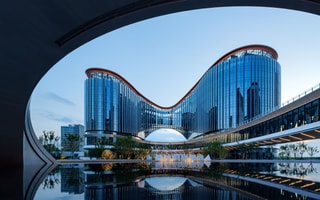
Designed by BDP, the 186,000 sq m development brings together two primary research centres, an administrative headquarters, conference facilities and talent accommodation. The campus provides a new base for CTTQ’s biomedical research and innovation, supporting research, incubation and commercial activity while strengthening Hongqiao’s position as a growing centre for biopharmaceutical innovation in the Yangtze River Delta.
BDP delivered the masterplan, architectural concept design, and schematic design for the development, bringing together different functions in a single campus designed around the way people work, collaborate and spend time.
At the centre of the design was an ambition to create a life sciences campus that is open, connected and useful to scientists and the wider community. As such, BDP designed a permeable campus that is open to the local community with two buildings connected by a central open space, creating a new piece of public realm within the development - giving the project a wider social role.

Four buildings with different functions are closely connected around this shared space. Administrative areas face towards the central heart, creating a visual and physical connection between different parts of the campus, while the two R&D buildings have their cores split between either end of the buildings. This leaves large, flexible floorplates that can accommodate changing laboratory requirements as CTTQ’s research develops.
The architecture takes inspiration from the structure of cells, with individual building forms growing and connecting organically across the site. This approach gives the campus a distinctive identity while responding directly to the scientific work taking place within it.
“This is a place for research within a campus that doesn’t turn its back on the city or the people using it. The central heart opens the site up to the public, while the buildings are planned to make research, collaboration and everyday life work together.
“We’ve paid close attention to the things that make a difference to people’s working day – access to daylight and fresh air, places to meet, eat and exercise, and spaces to step away from the laboratory. For CTTQ, this is a research campus built for change, but also a place for people, a place with a strong sense of identity and an identifiable connection to Shanghai.”

The design breaks down the scale of the campus into a series of destinations, activities and amenities, helping create a stronger sense of belonging across the development. Cafés, a canteen and gym are located at the lower levels of the buildings, bringing everyday facilities directly into the working environment.
A large second-floor connection links the different building units, providing an efficient route through the campus as well as a series of internal and external spaces where people can meet, take a break or spend time outdoors. Natural ventilation, nursing rooms distributed throughout the buildings and vertically arranged green spaces are integrated into the design, putting the practical needs of users alongside the technical demands of laboratory research.

Environmental performance is integrated into the architecture from the outset. Passive design strategies include façade solar shading informed by detailed solar analysis, alongside customised façade designs responding to the different orientations, spaces and functions across the campus. Low-E glass is used throughout to improve energy performance, and a large array of photovoltaic panels inhabits the roof. Their arrangement creates a distinctive fingerprint pattern, linking renewable energy generation directly to the architectural identity of the campus.
The new flagship headquarters is an exemplar of how design can bring beauty, efficiency and social value to the global life sciences industry. With science outwardly on show to a wider public audience, it will provide CTTQ with a base for attracting R&D talent from across the world, while developing collaboration with universities, research institutions and pharmaceutical R&D and manufacturing partners. The company is also looking to explore emerging areas including AI, big data and new materials, alongside an innovation ecosystem fund, supporting promising biopharma teams and technologies for the future.
Further Reading
CTTQ Pharma Global HQ
A 186,000 sq m, cutting-edge, sustainable workplace that enhances efficiency while prioritising the wellbeing of both employees and end-users.