How Design Drives Carbon II
BDP Quadrangle’s How Design Drives Embodied Carbon II: Upfront Embodied Carbon in 100 Projects report analyzes upfront embodied carbon across 100 of the studio’s projects, expanding last year’s envelope-focused study into a whole-building analysis of both structure and envelope.
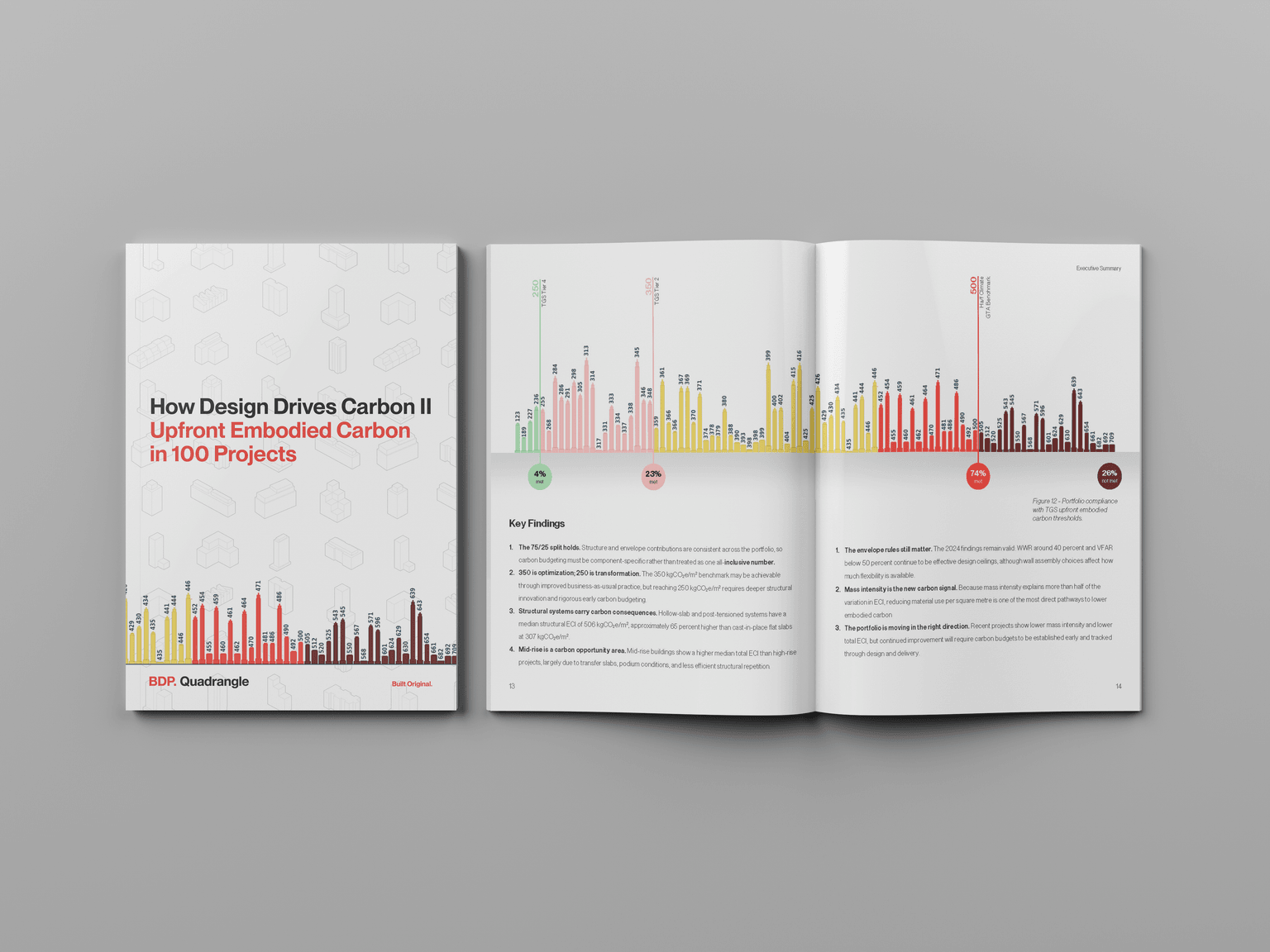
One of North America’s largest embodied carbon datasets is telling us where design needs to change.
The findings are clear: structure sets the carbon baseline. Across the residential dataset, structural systems account for roughly three-quarters of upfront embodied carbon, making early structural strategy, carbon budgeting and material efficiency essential to meaningful reduction.
The report marks a shift from carbon reporting to carbon intelligence. Through BDP Quadrangle’s Carbon Flow process and proprietary Carbon Tool, project teams can test carbon impacts earlier in design, when decisions around form, structure, façade and material use can still shape outcomes.
Developed in collaboration with structural engineering partners and supported by student researchers, the report reflects BDP Quadrangle’s practical, industry-based approach to applied sustainability research.
BDP Quadrangle gratefully acknowledges Jablonsky Ast & Partners, RJC Engineers, Salas O’Brien, Honeycomb Engineering, Entuitive, Engineering Link Inc., and Blackwell for their contributions in completing the structural component of this study. The report also benefited from student contributions through the Design Research Internship Program (DRIP) at the Daniels School of Architecture at the University of Toronto and the Eco Canada Employment Program.

How Design Drives Embodied Carbon II
Read our new carbon Report which analyzes upfront embodied carbon across 100 of the studio’s projects, expanding on last year’s envelope-focused study.