Raising the bar for building safety and accountability
The Grenfell Tower tragedy remains one of the most harrowing chapters in the UK’s built environment. 72 lives lost in circumstances that exposed deep-rooted failures in regulation, construction practices, and accountability. As the final report laid bare the systemic shortcomings across the sector, it also ignited a fire for change that could not be ignored.

The Building Safety Act represents legislative reform and perhaps a moral reckoning. It challenges our industry to own its past and do better. For those of us shaping the future built environment, it is more than the day-to-day; it’s about restoring trust, prioritising safety, and putting people first. The Act demands stronger regulation, greater transparency, and a shift in culture that places people and integrity at the core of every decision.
As designers, we recognise the gravity of this moment. It’s the start of safer, fairer, and more accountable spaces for everyone, but it also restructures a fragmented industry, where responsibilities were often unclear and compliance was inconsistently enforced.
The new Building Safety Act introduces a structured, risk-based framework designed to raise standards and accountability. Central to this reform is a tiered system that ensures greater scrutiny for higher-risk buildings (HRBs) while demanding clarity, competence, and transparency across the board.
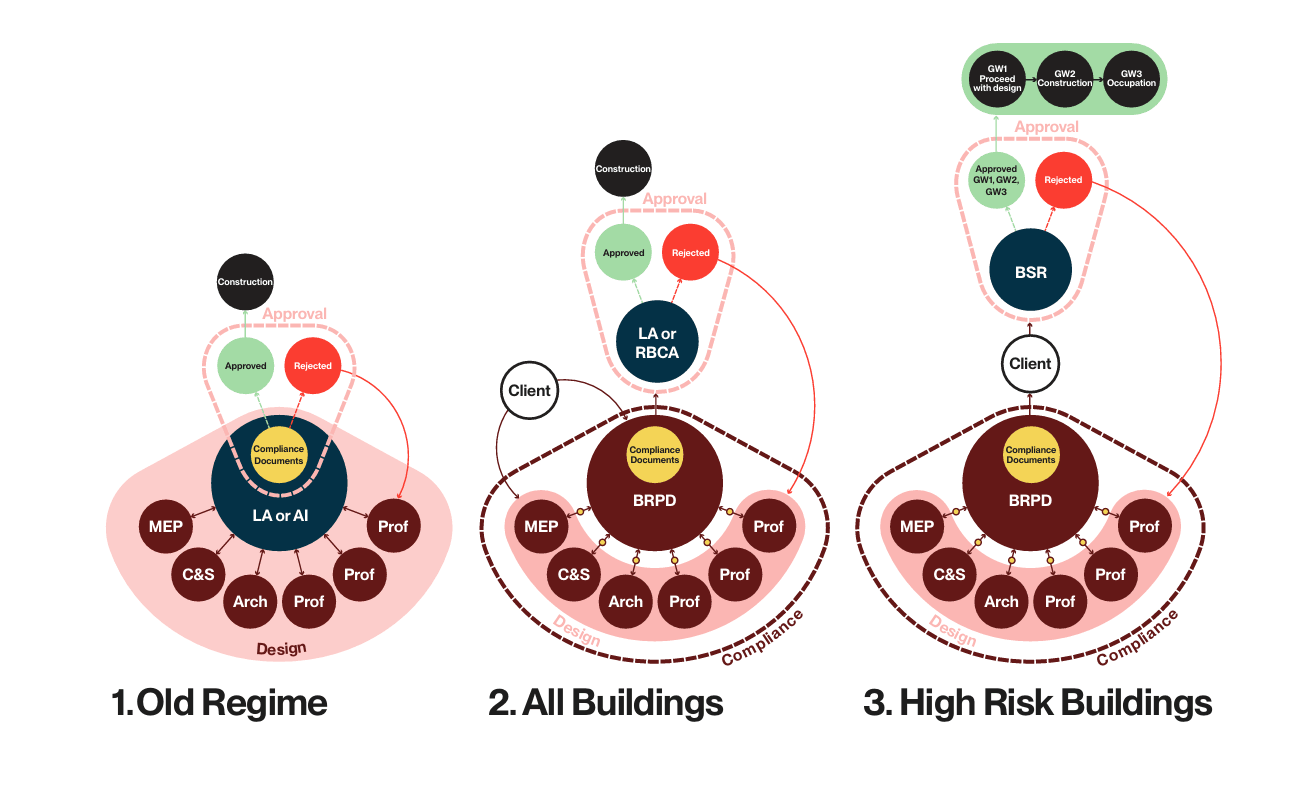
One of the most significant changes is the clear separation between design and approval activities. It’s a necessary shift from the previous system, where overlapping duties often led to confusion and gaps in responsibility. As part of BDP’s internal training, a visual diagram highlights how these reforms reshape the regulatory landscape, illustrating two distinct pathways for building approval: one through Local Authority Building Control (LABC) or a Registered Building Control Approver (RBCA) for standard buildings, and the other exclusively through the Building Safety Regulator (BSR) for HRBs.
The introduction of the Building Regulations Principal Designer is another key development. This role carries the responsibility for planning, managing, monitoring, and coordinating building regulation compliance during the design phase. Each designer now provides clear compliance documentation, visibly distinguished in yellow within the diagram, helping ensure transparency and accountability throughout the process.
Importantly, the Act places a greater burden of responsibility on the clients (particularly for higher-risk buildings), who must now take ownership of submitting all design documentation directly to the BSR. It’s a decisive shift towards aligning responsibilities with the gravity of risk and placing building safety at the centre of every decision. It is essential to recognise that every building project is subject to a strengthened regulatory framework. The Act creates explicit obligations for design teams: they must be clear on how their design work complies with regulations, and design documents must clearly demonstrate that compliance. This simple yet profound change means that every decision, from structural integrity to fire resistance, must be justified, recorded, and communicated.
By aiming to eliminate ambiguity, the Act instils confidence in clients and reduces project risks by ensuring that all design information is clear and easier to understand.
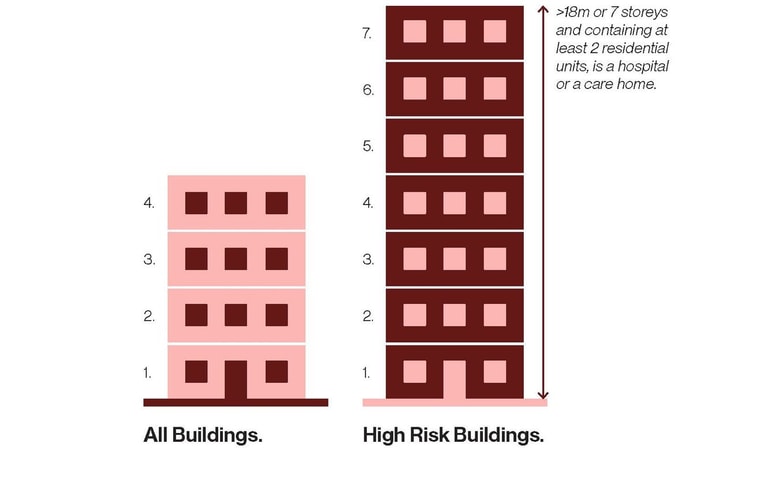
In England, for higher-risk buildings (broadly defined as those over 18 metres or 7 storeys with residential units, including hospitals or care homes), the Act is even more rigorous. Clients assume a highly proactive role, acting as a key duty holder throughout the project. They must ensure robust safety management, with design teams, contractors, and managers all maintaining detailed records of decisions, ensuring a comprehensive safety case is built, maintained, and available for scrutiny.
The “golden thread” of information, comprehensive and accessible throughout the building’s lifecycle, reduces client risk, as potential issues are identified and resolved earlier, with less opportunity for critical information to be lost.
Interestingly, many of the documentation and record-keeping processes developed for HRBs have broader relevance. On large, complex projects, even those that do not meet the HRB definition, designers are adopting these structured approaches to systematically record their decisions and communicate accurately using accessible information. This not only meets regulatory expectations but also creates a culture of curiosity where transparency becomes a habit.
The Building Safety Act is about resetting expectations and creating a highly professional culture. By demanding clarity and traceability in every project, the Act makes the built environment safer for everyone and reduces project risks. For higher-risk buildings, it brings the added discipline of governance and documentation practices which, when applied more widely, can improve quality across the industry.
The Act’s most enduring legacy may be that it empowers all participants - clients, designers, and contractors - to own the safety of what they build, from the drawing board to the building’s final years.