Reinventing the campus. How adaptive reuse is realising estate value.
Universities are at a turning point. Ageing estates, intensifying financial constraints, and urgent sustainability targets are no longer separate pressures. They are converging into a single, defining question: how can institutions extract greater value from what they already have?

For too long, post-war campus buildings have been dismissed as outdated liabilities – overlooked, underused, or destined for demolition in favour of new development. Heritage buildings give universities identity and prestige, but they face major challenges with aging infrastructure, poor energy performance, and limited adaptability for evolving educational and research needs. But that mindset is rapidly becoming obsolete.
A more strategic and forward-looking approach is taking hold that evaluates buildings not by when they were built or how they look, but by what they are capable of. When we assess these undervalued assets for their performance, structural integrity, spatial potential, adaptability, and campus context, they reveal significant untapped opportunity.
By reimagining and repositioning existing estates, universities can unlock financial efficiency, accelerate carbon reduction, enhance user experience and strengthen cultural and civic identity.
Adaptive reuse, when approached intelligently, becomes a catalyst for long-term value. It moves beyond isolated refurbishment to support the continuous evolution of campuses as dynamic, resilient environments.
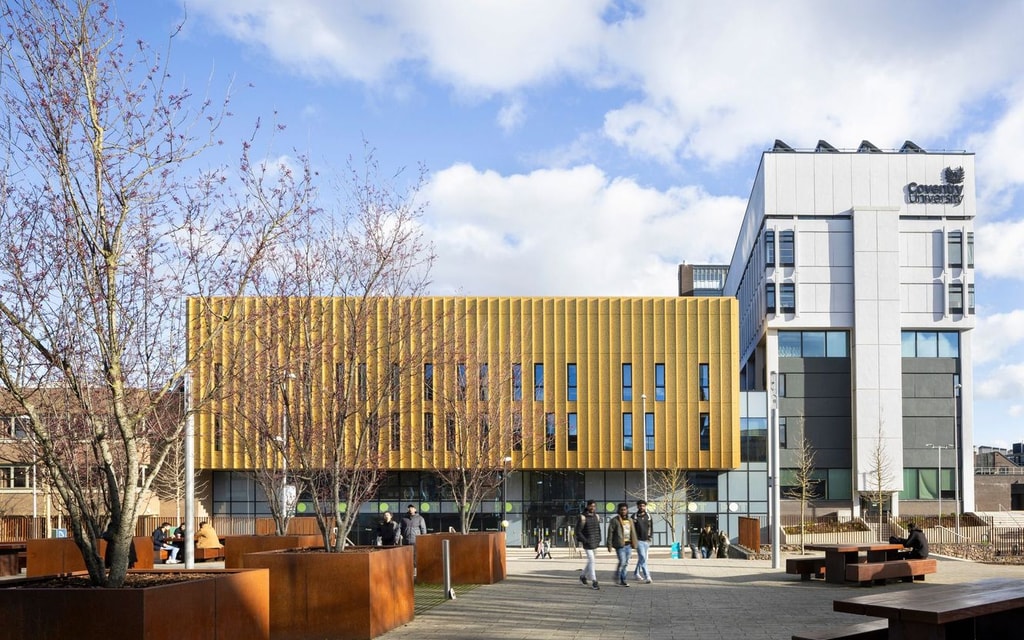
Coventry University’s transformation of the College of Arts & Society offers a compelling demonstration of what this approach can achieve.

Connecting City, Campus, and Community
Between the 1960s Maurice Foss and Graham Sutherland buildings sat a forgotten courtyard that was underused, disconnected, and socially absent. By infilling this void with a bold new public interior, the project knits the buildings together and establishes a direct link between the university, the city, and Basil Spence’s Cathedral.
In its place is a vibrant civic room, where university life spills into the city. It is a place to pause, showcase work, meet, grab a coffee, or simply pass through. It is simultaneously the college’s new front door and its beating heart.

The project is grounded in evidence not assumption. Extensive research revealed that nearly 80% of the original structure could be retained, with the post-war concrete frames offering remarkable robustness, spatial generosity, and adaptability.
This became the foundation for a transformation anchored in sustainability, practicality, and value:
- Light‑touch refurbishment improved fabric performance, acoustics, and daylight, while preserving inherent spaciousness.
- Reorganising the estate turned fragmented buildings into a coherent ecosystem for students, staff, and the public.
- Reframing 20th century assets as adaptable, high‑performing, flexible, and future-ready structures.
Sustainability was a strategic act, embracing longevity, reducing embodied carbon, and celebrating history while propelling the institution forward.
The College’s extraordinary mix of disciplines, called for a fundamentally different approach to organisation. Instead of dividing the plan by department, spaces are arranged by function, creating powerful opportunities for cross-disciplinary interaction.
The building supports:
- New pedagogies and hybrid teaching models.
- Inter-disciplinary collaboration through shared hubs and social spaces.
- Visual connection, allowing creativity to be seen, heard, and felt across the building.
- Large, flexible rooms that adapt as curriculum and technologies evolve
This is a place designed for experimentation, invention, and the messiness of real creative work blended with technology rich immersive environments. A place that encourages students to cross boundaries, physically and intellectually.
At its core, the project creates a generous new social landscape, nurturing innovation, celebrating diversity of disciplines, and welcoming the public in.
What was once a cluster of inward‑facing blocks is now a dynamic civic forum;
a sociable hub, a platform for ideas, and a driver for creativity.
The project demonstrates how adaptive reuse, when guided by intelligence and ambition, delivers exceptional value for clients:
- Financial: A major upgrade without major demolition.
- Environmental: Significant embodied‑carbon savings and long‑term resilience.
- Academic: High-quality, flexible learning environments that elevate the student and staff experience.
- Civic: A stronger connection between university and city, reinforcing identity and cultural presence.
As the university notes, it “achieves so much” – not just aesthetically or functionally, but strategically.
This project signals how institutions can think about their existing assets. It shows that adaptive reuse is not a compromise, but a catalyst for:
- Reframing value across entire estates
- Supporting ambition under fiscal constraint
- Strengthening identity and sense of place
- Creating environments that inspire creativity and collaboration
- Building with generosity, flexibility, and future agility at their core
Coventry’s College of Arts & Society is not just a refurbished set of buildings.
It is a reimagined place, that embodies the university’s character, serves its communities, and lays the groundwork for the next generation of learners, makers, and thinkers.
Central to the project’s success was a deeply collaborative design process, one that actively engaged its future users. Reflecting on this, Academic Dean Dr Shaun Hides commented:
“Huge thanks to the BDP team for an outstanding building that’s already proving its value in use. The BDP design user engagement process was critical to this success and was exemplary. This investment transforms what the college can offer, giving students and staff inspiring, state-of-the-art spaces and a rare chance to make significant progress."
This project is a fine example of how university estates can realise their full potential and actively shape institutional identity and experience, when freed from inherited assumptions.