Collaboration and healing at the heart of design at the Indigenous Hub
The Indigenous Hub – a first-of-its-kind mixed-use urban development in Toronto’s Canary District has been completed.
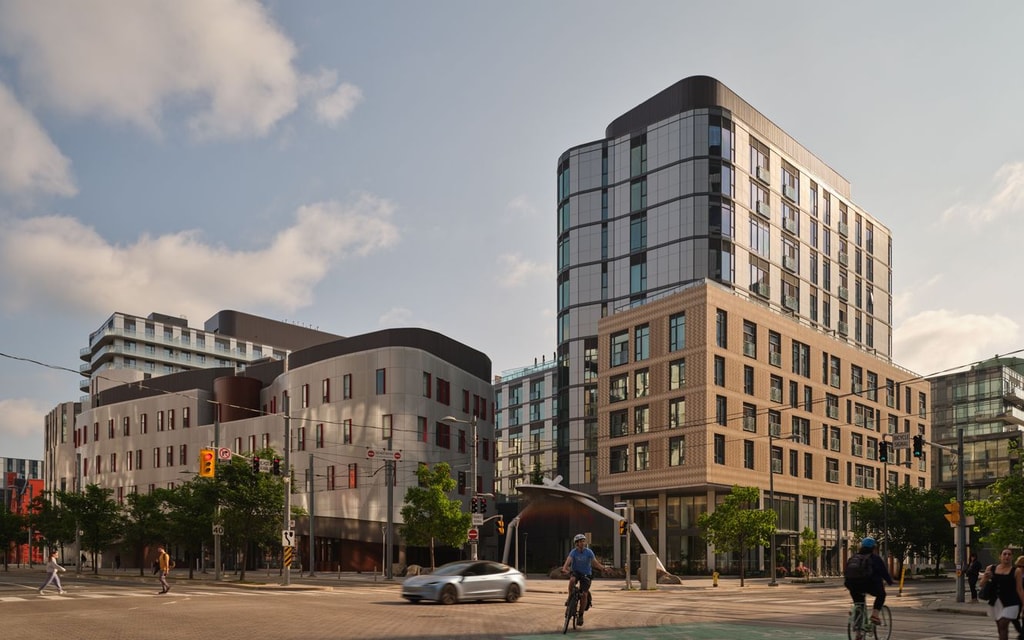
The development has risen as a 440,000 sq ft cultural landmark, healing space and architectural act of reconciliation. Occupying an entire downtown block, it brings together a 4,000 sq m Community Health Centre for Anishnawbe Health Toronto (AHT), the Miziwe Biik Training, Education and Employment Centre (TEEC), and two mid-rise residential buildings, Canary House and Birch House, providing around 400 homes alongside civic space and the central Indigenous Peoples Landscape. Every design move – from door handles to building orientation – was reached through mutual respect and co-creation with the project team. The result is a contemporary architecture deeply infused with Indigenous perspectives, held in respectful parallel with Western design traditions.
The project is the outcome of more than two decades of commitment by Anishnawbe Health Toronto and its late executive director Joe Hester, alongside Indigenous employment and training leaders Miziwe Biik and the development consortium of Dream Unlimited, Kilmer Group and Tricon Residential. It creates a place where the approximately 70,000 Indigenous people living in Toronto can access culturally grounded healthcare, education, childcare, training, commercial space and housing.
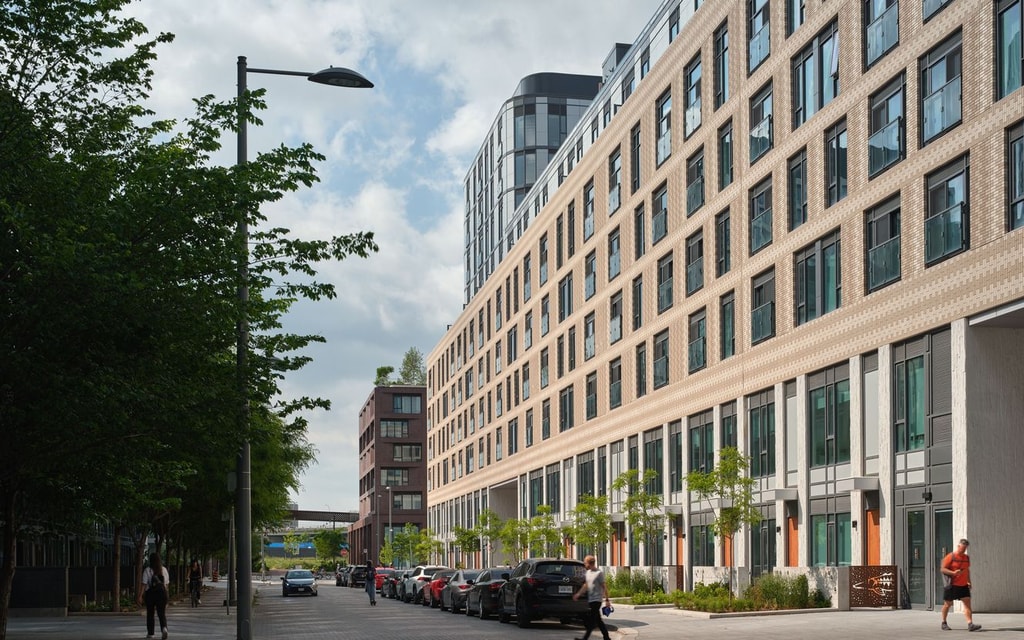
It was designed through deep collaboration between Two Row Architect, BDP Quadrangle and Stantec, along with contributions from ERA Architects, NAK Landscape Architects, and Elastic Architects, as well as construction management by EllisDon.
Located on ancestral lands used by Indigenous peoples since the retreat of the glaciers, the transfer of the 2.4-acre site from the Province of Ontario to AHT – which Hester described as a “return” – enabled the creation of a centre for urban Indigeneity and inclusiveness.
Drawing on the Two-Eyed Seeing principle, which holds Indigenous and Western ways of knowing in balance, the Indigenous Hub reconnects people to land, place and each other. Its form, materiality and orientation were developed through co-design with Indigenous voices, guided by eight key principles including directionality, the movement of the sun, the use of earth-based materials, Indigenous planting, and an emphasis on craft and curved, pebble-like forms.

“Our goal was to create a community of inclusiveness. Inclusion was a core principle guiding everything – from material choices to public space access. This project is not just symbolic, it is structural. It is not a gesture, but a grounded return. It is a space of healing, a platform for community-led growth, and a new urban typology born of Indigenous values.”
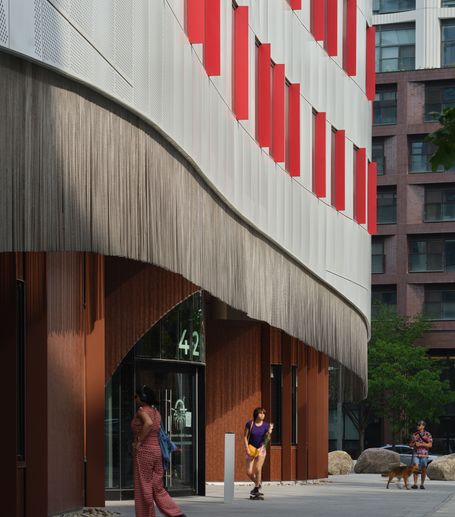
“Our role was to guide the translation between Indigenous knowledge and architectural form. The atrium of the Health Centre faces east. That’s the direction of birth, the direction where the sun rises.”
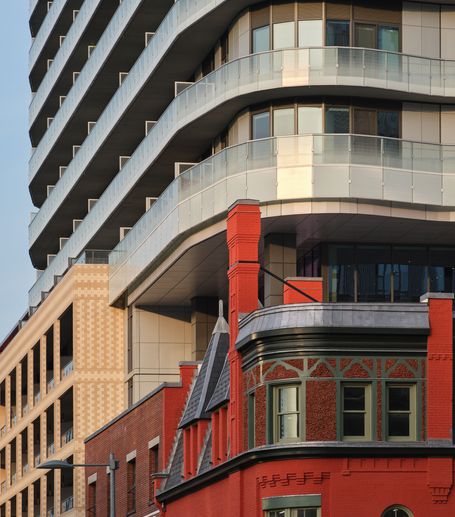
“It is an honour to contribute to a new and much-needed layer of Indigenous culture and presence within the urban fabric of the city. With an approach grounded in the land and landscape, the Indigenous Hub will be a unique urban experience in Toronto.”
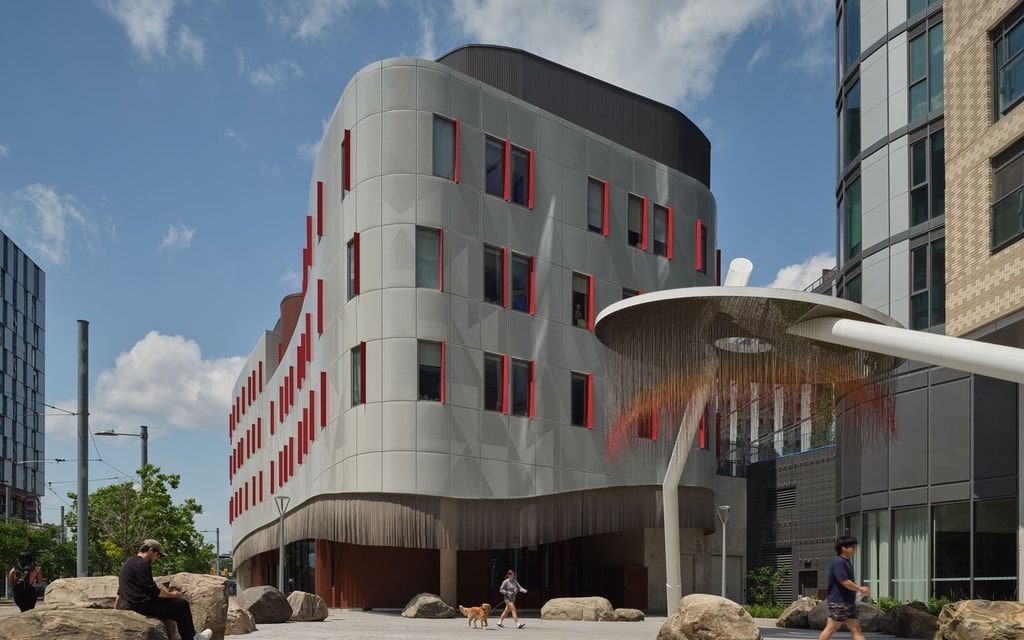
A defining move was the decision to remove the parking structure from beneath the Health Centre so that it could sit directly on the land, as Joe Hester insisted, “with its feet on the ground”. The building’s curved façade and three-storey atrium are inspired by the act of wrapping a shawl around a loved one, opening at the heart to the east and creating a transparent connection between ground, sky and light. Materials avoid associations with colonial institutional architecture, favouring cast-in-place concrete, aluminium, weathered steel and warm timber.
For the residential podium, BDP Quadrangle and Two Row Architect reinterpreted brick in precast concrete panels woven with embedded units, drawing on Indigenous basketry and blanket-weaving traditions. The Miziwe Biik Training Centre references birch groves native to the Don River through textured panels and staggered vertical windows.
Landscape is integral to the project. Bioswales, curved paths and the Indigenous medicinal gardens are planted with species such as sage, sweetgrass and tobacco, while boulders and pebble forms recall the historic Don River delta. The raised Indigenous Peoples Landscape, along with a children’s play space and civic plaza, provides places for gathering, ceremony and everyday connection.
The collaborative effort between Indigenous and non-Indigenous designers and partners demonstrates how reconciliation can be embedded in the fabric of the city.
The Indigenous Hub stands as a powerful example of how urban renewal and Indigenous resurgence can work in harmony, shaping a future city that honours culture, restores presence and supports healing through design.
Further Reading
Indigenous Hub
Located in Toronto’s Canary District, the Indigenous Hub is a precedent-setting, 440,000-square-foot mixed-use development.